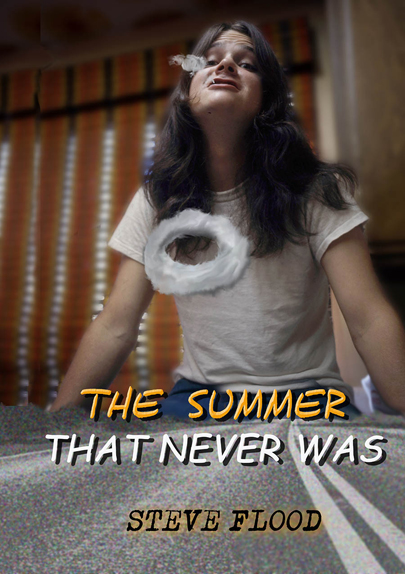
The Summer That Never Was
By
Stephen Flood
The desire for absolute freedom ranks among the essential longings of man, irrespective of the stage his culture has reached and its forms of social organization
Mircea Eliade
Madness prevailed over reason, he resolved to have himself knighted by the first person he met…letting his horse take whatever path it chose, for he believed that there in lay the very essence of adventure.
Cervantes
The Summer That Never Was
By Stephen Flood
Copyright 2013 Steve Flood
ISBN 978-1-30-109991-7
Table of Contents
Chapter 1 – Bloxom’s Boots
Chapter 2 – The Shadow
Chapter 3 – Green Eyes
Chapter 4 – Bells and Balls
Chapter 5 – Sparkey’s Shotgun
Chapter 6 – The Berkeley Police Hat
Chapter 7 – Into The Pit
Chapter 8 – Truth or Dare
Chapter 9 – Thistle Picking
Chapter 10 – Fugitive At Last
Chapter 11 – Psylocybin
Chapter 12 – A Debt To Your Angels
***~~***
1
I’m not sure when the thought first occurred to me, but there was a first time; a thought so sudden and complete that there was no recollection of how things were before it. I would often look out the front window and watch the pine tree in our front yard list to one side then straighten, as if some miracle had occurred. That’s when the feeling would come—the smell of dirt, falling through my fingers, it wasn’t dirt anymore, it was something else.
It was too hot to sleep, even the mocking birds sounded tired. I lay on my bed in my boxer shorts and listened. Something didn’t feel right, like the pause that comes when you know for certain you’re about to get caught. Then it started up again, rattling the metal casing of the machine next door, the thermostat must have peaked and shut it down, which was rare, now it was up to speed, whirring contentedly, back to normal. We didn’t have air conditioning, my father didn’t believe in it, our house was anything but normal, we had the seasons, we wilted, we had the swim club. It was the water that saved me.
Most people think you’re only baptized once, the month after you’re born, but that isn’t true, there are other baptisms; other ways of being born, even the hills can be baptized, the winter rains leave them draped in green when spring comes, like Robin Hood’s cape. Green was my favorite color and he was my first hero and he would teach me things, things my father didn’t—how to string my bow, slay the dragon, turn lead into gold. He was an outcast, like the color green in summer, you couldn’t find it anywhere.
Every year I felt like I’d been banished from spring, thrown into the dust, cast into the fires. It was hot, burnishing hot and my only redemption was the water, I’d immerse myself, like a fish, like an amoeba, groping.
Tbone wasn’t much different, he was struggling to be reborn, just like me, only it wasn’t with water, it was with fire. He was a glowing coal and water could extinguish him, he knew it instinctively, like the hills know it, when the first shades of gold streak the verdant stems, and the winds begin to blow and dry them into withered chaff. I didn’t do it like Tbone, but I understood him, he had his reasons, nature has its reasons.
He didn’t hate it, no kid hates the water, but he hated the club. Ever since the operation on his ear it didn’t matter if the sun blazed and the asphalt was hot enough to blister his toes, he wouldn’t go near it. The only reason he went that day was because of Gracie Mooseman and right after I called he hopped on the Flyer, a wide tired girls bike with a double spring seat.
Pulling off the road and onto a path, he took the shortcut across the old Farm lands. At one time peaches grew the size of fists and plumbs and grapes in bushels, down to the railroad tracks at Hookston Station where the Southern Pacific would pick them up and ferry them off to market. Then came the last harvest and the houses and the GI bill and the baby boom. But that was a generation ago, maybe two. Now the trees stood barren and ravens gathered in the denuded branch tops, bickering. One time I shot one, right through the eye. It just sat there without moving like a rusted weathervane, then dropped like a stone. When I found him the BB went clean through his head and blood was coming out the other eye—I never forgave myself.
He swore he’d never set foot in there again, not after the last time, but he’d do just about anything to see Mooseman in a bikini. At the ditch behind the dead end at Marlee Road, he lit up the smoke from his mother’s purse and pitched his lips. “Fucking toads,” he said out loud, tossing the butt before it was half done then leaned back into the crank.
She didn’t care about the Parliaments, as long as it wasn’t her last one, but if you ever called her Lillian, she could put her Irish into it. Sean said it was the hot flashes, suddenly she would just jump out of her skin, especially when she caught us screaming in his good ear. Other than calling her Lillian, it was her biggest annoyance, she was terrified that one day he would end up as deaf as a thumb tack. Every summer she took him in for a new set of ear plugs, it was the only was Doc McCutchins would let him go near the water.
Creedence Clearwater Revival was a local band from College Park High, for the past week, every time I saw Tbone he was singing SuzyQ, claiming they proved there was a future in playing Rock and Roll, even if you came from Pleasant Hill.
He pounded out the bass line against the chain guard picking up speed as he hit the incline, straining to reach the top without loosing the beat. Just as he jumped the culvert, it was in his face; a scrap of painted tin hovering above a wall of pyracantha. Somehow it summarized all that was wrong in the world—Private Drive Pool Members Only, as if it were the gardens of Babylon instead of a concrete hole in the ground. He had a point, just because it was sequestered down a shady lane and they had whistles, it didn’t give them the right to lord it over everyone with their uberous pool rules. I wouldn’t wear a swim cap either. But with his hair, he would grow it down to his knees and couldn’t care less about the rules. What enraged him even more was the thought that he was one of them, as if that were possible—luciferous, unhinged, there was no turning back, not for Tbone.
Everyone had long hair in those days and no one followed the rules, but we didn’t break them just to break them, we had our reasons.
The reason I let Jacque Bloxom keep his boots in my locker was because of my sister, not that I blame her but I hardly knew him. All winter he went around school barefoot kicking a soccer ball at lunchtime, even after they split up, so when he asked to borrow it, I thought he was just trying to impress her, why else would he ask to keep an old pair of army boots in my locker? At the time it made perfect sense to me.
Perhaps I should have known better, he had a reputation. Every morning for the past month he drove through the tunnel with his brother, over to Max Scherr’s on Oregon Street to pick up a stack of Berkeley Barbs. It was only chump change, enough for a lid or a burrito from Mamacita’s, but if it gave him a chance to hang out with his brother, he didn’t care, there weren’t that many days left.
If they had ten or fifteen dollars after paying for gas, they bought them outright, if they didn’t, they’d offer up the Nikon as collateral. If it was early, he’d go over to Shattuck by the YMCA and hawk them to the commuters taking the Metro. If someone beat him to his favorite corner, he’d go on to campus, even though he could get busted for selling the Barb on University property. The pigs were everywhere that summer.
Afterward, at Marcella’s pad, they’d smoke grass then walk around the alleys and hang out with the freaks making music on washboards and empty five gallon plastic buckets. He was welcome everywhere with his hair, loppering over his forehead like corn shucks.
But all that changed with the gas, everything changed when the gas came down. That was the day his brother got drafted. Just after he disappeared behind the big glass doors at the Oakland Induction Center, he sat on the sidewalk wondering if he would ever see him again, when it fell from the sky. Ubiquitous, diplopic, he couldn’t fight it, that was like fighting ghosts. He had to hitchhike home, but back then, it was easy to get a ride. He walked the last two miles with his eyes swollen as much from the gas as missing his brother.
***~~***
Johnny Martin rarely came to practice anymore, but our relay won the county meet anyway. He was a natural. But Tbone was skinny as a strike anywhere match; he couldn’t swim to save his life. It wasn’t his fault, he was born that way. Lately, she’d been coming to the club with her boyfriend in his bug. He couldn’t help that either, she was an angel.
Wheeling through the lot, past a row of cars grilling in the heat, he let go of the handlebars, stretched out his arms and let off a Yahoo, “Baby I love you, Suzie Q.”
He leered over at the VW, shoving the kickstand to ground. Despite the odds and his mid-summer blues, he would find what he was looking for, or else.
Unless you counted the night Mary Birnbaum stuck her hand down his pants and pulled out his pecker without unzipping his jeans, he was still a virgin. Down the steps, shaded by lurching elms, his unruly mop falling over his bony shoulders, he felt like a wind blown skirt. It was the poster of Marylyn Monroe that hung over his brother’s bed, opposite James Dean standing up against a brick wall, and then, just as suddenly, he thought of the other two, Joplin and Hendrix. ‘What’s the fixation with death?’ he pondered, giving the girl at the check-in desk a cool nod. To Tbone, death was as far away as Jupiter, but his brother was different, for him, it was just around the corner. It’s hard to explain the disparity, they were less than a year apart.
“Tbone,” Martin’s voice broke through his brooding, “we’re over here.”
“I’m going in,” he yelled back without looking.
I watched him cross the lawn with a scowl on his face.
Sloughing his sandals, he unbuttoned his denims, jammed in his earplugs, and dove. Hardly a ripple followed.
“Four three,” the ball ripped over the net. There was no way to stop that. The thing I always liked about Johnny Martin was, he could beat me if I wasn’t careful.
***~~***
Right when he got home he wrote him a letter, but he never sent it. He didn’t send the next one either and by the end of the summer he had enough to publish a book. The last one he put in an envelope, addressed it, even paid the postage, but just in front of the mailbox he stopped, I don’t know why, he just couldn’t do it.
The one that he finally mailed had none of the banter like the others; none of the longing, or the shock he felt every day when he woke up, as if snow melt was thrown in his face. That one didn’t mention the games they used to play, shooting the carbine he cut out from a barn wood plank with a coping saw, killing Nazi’s with the best throaty gun noises in the neighborhood. Or years later, at the street demonstration, through the alley throwing rocks and running from the pigs, helpless to do anything about it in their riot gear and plastic face shields. That was just a game too. But it wasn’t a game anymore.
What he did send him was a recent copy of the Barb. Sherr was calling himself Max the Oinker, threatening to sell it off, his only child, proclaiming he’d been betrayed when all of his writers quit, leaving the paper to start up a new rag called, The Tribe.
‘Even the Barb,’ Bloxom thought, sitting on his bed, ‘everything was coming to an end, except the war.’ He looked out the window at the tree fort they slept in, every night, even after school started up in the fall. One of the rails had broken off, but it was still solid after all these years, and I know it hurt. He could feel it beating but it hurt.
Once you got over the hills, the heat was like an oven and every summer from the time I could remember the only way to stay cool was to head for the club. But who can say what brought us together—a time, a place, coincidence—we had no tolerance for boredom and to suffer the company of a square was like having your face peeled off and stuck in a jar. Born in a bog is how my dad once put it. It created bonds like hoof glue.
His fastest stroke was the butterfly, but I could swim all of them.
Every Sunday she played the organ at Christ The King and his dad was so straight you could measure his walk with a drafting tool. My dad was a nuclear engineer and split atoms for the government. I used to imagine him going off in a pinstriped hat with a hatchet, but that didn’t explain much, he was still a toad. All parents were. We spent all summer at the club but decided long ago, we weren’t going to turn out anything like them.
But Mr. Rawls was different. When he swooped through the gates of the Pleasant Hill Aquatics Swim Club, he looked like he could kill something. He just finished reading an article in Readers Digest about a coven with tattoos and tongue studs and looked down at the blond girl with the black lips and wondered. But like all toads, he was jumping to conclusions. The lipstick she applied in the restroom at the Mobile gas station on Gregory Lane, because her mother would never let her wear it when she left the house, was a fashion statement, nothing more.
“Your name, sir?”
He grunted, without acknowledgment.
He wasn’t there for a cool dip, he was on a mission. And right in the middle of the pool—his upturned lips rolfing the air.
All he ever talked about was his son, the Olympic champion. But last night he was so drunk I thought he was going to drive into a telephone pole.
***~~***
Jacque had a right to be pissed off, but I don’t know how he got the nerve to call my sister. She just hung up on him. I couldn’t blame her, the volume of discontent was noxious, Vietnam, the gas, the Barb, the pigs, especially that pig Max, ripping everyone off, expropriating profits and paying his writers minimum wage. After that, he didn’t want anything to do with him, or the Barb or even Berkeley, but it was the only way he could get his Nikon back. He stopped in at Marcella’s and after a lounge on the couch, blowing facefuls of smoke at one other, he managed to talk her into going over and picking it up for him.
“I’m OK with that,” she said, her eyes squeezing through the shanks like an arboretum. “I don’t think he’s a pig, when he started it, he was processing rolls in his kitchen sink, he can do what he wants, it’s a free country,” She sashayed around the corner and across Grove Park. Later, they met up at Moe’s, browsing the stacks and giggling through the comic strips. When she held up a copy of the Austin Rag and turned to The Fabulous Freak Brothers, starting in on a stand up routine right in the aisle, Jacque framed her perfectly with his Nikon and snapped one off.
Everyone has an angel, but even the benevolent ones demand something in return. When they cease to be amused they can be quick to anger and above all they cannot be cheated. I felt sorry for him, he tried everything, but when the draft board withdrew his deferment, his time was up. And the night before, gawping at the forbidden fruits of the wandering Jewess splayed out on the backseat of his dad’s Oldsmobile, so was Mikie’s. Jacque didn’t have a dad, which may explain why he started smoking pot when he was twelve. But Mikie did and his angels had grown weary.
When Mary Birnbaum put on a pout and mewled in his ear, we had now idea he would end up sitting on the kitchen chair, like a lump of Jell-O. I didn’t have any and neither did Johnny Martin. I’m not making excuses, we had ulterior motives, but there’s no excuse for narcing someone out.
“Tbone was there, and we went out to the parking lot, because I had the car,” he stammered, averting his face, split open like an over boiled hot dog.
“…they made me.”
“They,” he asked, softening a little, “made you do what, son?”
“She told me if I got the bottle in the trunk, she would show me…
“What!”
“I didn’t… I mean, I knew you had the whiskey, everyone knew it. We had a little that’s all…”
“What do you mean everyone knew it!” Blistering, his blood pressure took a jolt, “What did she show you?”
“Nothing, I swear it. It was Tbone, he said if I took a puff, I could see it.”
“See what?”
Before he could answer, he let out a bellow and the whole room seemed to shake, turning his rant into something queer, and Mikie, already disoriented from a night of binging, then the muff in his face, had no idea what to expect next.
“I hope you learned your lesson, son.”
“I did, dad,” he conceded, surprised at how easy it was. All he had to do was narc.
“Get up to bed and sleep it off,” he said, as if giving him his blessing.
So off he went.
At the table, he sat reminiscing over the time he smoked a cigar and barfed on his own Wing Tips. He didn’t want any more filching of his private stock, but what was a little whiskey. He will never turn into one of those freaks, like the Brown brothers, he fumed. That Monkey album? He probably got that from the Browns. It was a curse, right next door. For the life of him he couldn’t understand, smoking and drinking, that was normal, but these fairies prancing about the stage, hooting and reveling.
“Hey, Hey I’m a Monkey,” the lyrics grated across the roof of his mouth like sandpaper. Flipping the bird, calling them pigs, was the entire generation going back to the jungle?
“He will never drop in and tune out, or whatever,” he said, with conviction. Yet something wasn’t right, he could feel it, just under his skin, like a sliver. How did he put it? A puff? “A puff of what?”
He sprang from the chair like cannon shot and stomped up the stairs.
***~~***
Why would you want to bring down anyone that hard? Looking back, I couldn’t blame him, he must have thought he was doing the right thing, just like Nixon did, he just didn’t know what he was up against.
Jean Bloxom didn’t know what he was up against either, he came out of basic training like a left threaded screw. His whole world turned upside down when he got to Nam and Jacque didn’t hear a word from him all summer. Where was he supposed to send it, general delivery, the Army?
The rag rack at Moe’s Bookstore had publications from every underground newspaper in print, even articles from the College Press Service. Bloxom followed the story of the Berkeley Barb with almost as much interest as he followed the news of the 101st Airborne. That’s where he found the article by the Quakers, in one of the GI rags. The American Friend’s of Service were calling on all men in uniform to lay down their guns and start singing the psalms, instead of the Caissons rolling along. He kept that issue of the Ally, read it cover to cover a dozen times and never went back to Berkeley the rest of the summer. If the Barb hadn’t folded, who knows, things might have turned out different.
***~~***
I didn’t notice him, seething in his nylon breeches, Martin had a wicked serve. I couldn’t have stopped it anyway, all energies must reconcile, even the contrary ones, it’s the law, sometimes it only leaves one man standing.
He couldn’t just order him out of the pool and demand an explanation, his upturned girly lips, he wouldn’t stand a chance. He needed proof. He surveyed the empty beach towels, imported flip-flops, webbed satchels, and multicolored umbrellas until he found his mark—a pair of huaraches. He hated those slabs of cow hide, worn ceaselessly ever since that exchange program to Michoacan, strung together like an unfurling hammock, tattered from rain and rotting winters, sun and summers.
Standing over his unleavened pile, looking down at a bath towel. The club with a bath towel? He spread his own floral print, shaking his head in disgust, casually flipping open the pages and coming to the story about a housewife who ran amok, killed her husband, three kids and the dog. It was in all the papers before the expose in Life Magazine.
“Egads,” he said aloud, everywhere he turned it was in his face; the mark of the beast. From the corner of his eye he caught sight of his rucksack lying underneath a T-shirt with the word Grateful and part of a skull glaring back. Looping the strap around his toe, he shuffled it beneath his towel.
“Nineteen to Twenty, game point.”
Martin put a forward spin on this one, keeping it low to the net, accelerating as it glanced down on my side.
“Rawls,” I said, without taking my eyes from the table.
“Thought we wouldn’t see him for a week, he was falling down,” he laughed.
“His dad.”
“With him?”
“Just his dad,” I nodded.
He glanced over at his towel, “Shit…he’s busted.”
Piece by piece, probing with the spine of his magazine—an adult comic book, an earplug case, a hairbrush, and a pair of worn weight lifter gloves with the fingers ripped off. “What would he need these for?” he harrumphed, popping open the case, amused at the thought of Brown lifting a barbell—Brown with his deaf ear and girly lips. He didn’t consider that the gloves helped fight off the frost, heaving papers every morning from the Flyer onto all the front porches in the neighborhood.
Martin slid over the water with a smooth angular stroke then dove below the surface.
“Tbone, you swim like a dying rat.”
“What?”
“YOU SWIM LIKE A DEAD RAT!”
“Bullshit, a dead rat swims like this,” he spread flat, face down, until I smacked him on the head.
“Rawls is here,” I whispered.
“What?”
Still mulling over his towel, he looked up and all motion in the universe stopped.
At the edge of the pool he pulled out his plugs, “Hey, are you looking through my backpack?” He asked, point blank.
***~~***
He probably read every issue that he ever sold, but it was the first time he ever tried to write an article. He never had anything to write about until then. I know he felt helpless, like being thrown overboard. He had to find a rock, something to hold onto, it was his baptism. Digging through his mother’s closet, he found the old Olympus and spent a day pecking at the keys; the injustice that left him hollow, gasping for air every night. And just for the hell of it, he sent it in. He didn’t expect it to end up in print, but there it was, sitting on the rag rack at Moe’s, right alongside Kaleidoscope and The Seed, bold as Helvetica, in a little box in the lower right corner. After two months of laying low, he felt his wings again. He called my sister, bragging about it.
Rawls didn’t find what he was looking for that afternoon, only because Tbone hid his weed in the bottom of his earplug case. They squared off shouting at one another, with an occasional, “that’s a lie,” or “prove it,” from us as backup. When he threatened to call the cops, Tbone was all for it, which seemed like a death wish to me, until finally the lifeguard came over and he told him to fuck off. That was suicide. That’s when Gracie left.
When they walked through the gate, he slipped his plugs back in. One stayed behind with his thumbs in his belt, eyeing the gathering crowd. The other one started in, “What seems to be the trouble?”
“Huh?” Tbone looked up, wide-eyed.
“He’s got a bad ear,” I explained.
The cop shot me a shut up or I’ll kick your ass look.
“Let me take these out,” he said, popping the case, leaving it open long enough for them to get a look inside.
“What’s in the bag?” The cop asked routinely, then pulled out the gloves, smelled the gum, turned over the hairbrush and flipped through the comic book with raised eyebrows. Tbone shot a Cheshire grin back at me. He didn’t give a shit.
He held up the case and queried.
“Can’t swim without them,” he replied, pointing to his ears.
He snapped it shut, handing it back, “We’ll have to call your parents.”
That’s when Lillian cut in, right out of nowhere. I wasn’t surprised, moms, like angels, always show up just when you need them.
“That won’t be necessary,” she said.
“It appears Mr. Rawls has violated the privacy of your son, Mrs. Brown.”
The square jawed one with the pinball eyes gave her the backpack. He knew the Browns; he was the one who busted Sean with an ounce, less than a year ago.
“If you would like to file a complaint, mam…”
“Is anything missing?” she asked, handing it back to Tbone.
“No mam, I do not believe…”
She turned, giving him the stare, “I am asking my son.”
“No,” Tbone replied, sheepishly.
“What were you looking for, Jack?”
“Like I told the police, I believe your son gave my boy some marijuana.”
“And what do you base this on?”
“Last night, he gave him a ‘puff’.”
“Is that true Michael?”
“I didn’t give Aqua Lungs nothing,” he replied.
“We will talk about this later,” she said, firmly.
“Yes mom.”
“As for this, we are neighbors,” she continued, then turned to the officer, “and the Bill of Rights applies to a teenager, the same as everyone. How would it be, if on my way in here, I opened your car door and riffled through the mail on your front seat?”
“Lillian, that’s just it, they were riffling through…”
She cut him short, looking over the top of her half moon glasses, “In the future, John, please consult me before taking action.” And that was that. Fran was our heroine, just about the coolest mom on the planet, even if she was a toad.
***~~***
I would never have admitted it, but I didn’t see anything with much clarity in those days, like waking up before pulling the sand out of my eyes. Finally enough had gathered to make a stone. You can skip a stone, or build a house if you have enough. You can carve a glyph on one, if you can pull it out of your eye.
The bowl of soup we got the next day was what it said on the menu, bottomless. After the showdown at the club, Fran offered to take us through the tunnel and out to lunch, but we suspected she had ulterior motives. History was unfolding right in our backyard and she knew it, but she could hardly have foreseen the impact of that afternoon. From that moment on, it was over the edge and free fall forever.
They took over the park with tents and dulcimers, dancing to the bongos, arm in arm, in one endless smile—We The People, it had the resonance of something grand. Reverence abounded and irreverence too, one coin tossed over itself, spinning out of control. Just the month before, James Rector got a hole blown in his stomach. The next day he died in a Berkeley hospital. Now there were flowers everywhere.
At the Bottomless Bowl on Telegraph, the soup came in army helmets and no one ever finished. We were four-squared and stuffed—me, Johnny Martin, Tbone and Sean. The one who started it all. He was the first, and by now his hair was halfway down to his ass, but he didn’t talk much at that lunch. Preoccupied in a frown and conspiring, he barely lifted his spoon.
After we ate, I wiped my chin on a coarsely stitched napkin cut from a flour sack and looked up into Fran’s eyes beaming over the top of her half moons, “Shall we go and meet the people,” she proposed.
Weaving in throngs, the avenue was a parade, awash with lovers and freaks, barefoot in bell bottoms, hippies in leather, cymbals clanging, silver and beads. We crossed the street and came to a fence spanning the park where a couple of college girls stood, beckoning from the other side. Behind the wire they looked liked prisoners of war, except for the flowers—big white daisies cradled in their arms. They handed us each one through the chinks. Patchouli, umbilical and suffuse aroused a memory so old and familiar that it seemed like I was standing in front the blessed virgin, until she leaned over. Through the dangle of her shirt, heaving up a chorus of the earth, in a voice like Siren’s, she became the other Mary. Molten pollen flushed through my veins.
Suddenly, she stood straight up and looked over my head. Hovering above me, back like a ramrod, M-16 at the ready, placidly scouring the horizon—what was he looking for, Injuns? She pushed a flower toward him, nearly touching his cheek, but he didn’t move.
Returning love with hatred is incomprehensible and I owe that to Fran. She knew it, as if she had always known it, and wanted to be sure that we saw it, live, and not just images on TV.
I stuck a flower behind each ear as we loped across the avenue toward Moe’s.
***~~***
Unlucky at the draw twice, Jean not only got drafted but was sidled up with 101st Airborne; the one division that was always in the shit. He never jumped out of a plane, he never volunteered for a mission, he rarely fired his rifle, and then it was only into the bush without taking aim. He wasn’t a coward, he just wanted to survive. Above all, he wanted to keep his sanity. In the months that followed, the only way he could manage that was to keep his head down and smoke as much weed as he could get his hands on. Whenever he could, he’d hop on a bicycle and peddle down the dirt highway. Over one stretch of road, houses with thatched roofs, women in straw hats, knee high in the rice paddies, waving as he passed. It was the strangest thing he’d ever seen, paradise in middle of purgatory.
One morning he woke up ecstatic, he’d been found. In his dream he was reciting the Lord’s prayer. He hadn’t done that since Sunday school, and figured it must be divine intervention. It didn’t last long, and when his newly found religion faded, there was nothing left to hold onto. One minute, the endless roar of the 155mm howitzers, making him puke, the next, a silence that lasted for weeks, so complete, all he could hear was the insects crawling though the jungle.
The boon from seeing his first article in print only lasted a couple of days and Bloxom didn’t do much of anything for the rest of the summer, except lay around in a funk he never thought possible. Until one day he stood up and smashed his fist through the drywall and shouted, “fuck this shit.” It was that afternoon that he sent the letter. He addressed it: Pfc Jean Bloxom, 101st Airborne, 506th Infantry Division, PO Box: Hell.
He was proud of that article, who wouldn’t be, it circulated to over two thousand readers. One of them even wrote him back, offering his support. He couldn’t figure out how a guy with a printing press in Denver could help with anything, but it was still a rush, knowing someone that faraway had read it.
Someone else read it that day too, over the morning coffee, sitting behind his desk at the San Francisco Regional Office. Along with a couple dozen other rags from the underground press, it was part of Agent Burk’s routine. He gleaned more information from The Barb than he did from the San Francisco Chronicle. It gave him a sense of style that was invaluable and made him a asset to the FBI. He often wrote articles himself, just to try his hand. Other agents had managed to hoodwink the pinkos and print in the Daily Worker or the black liberation rags like Right On, but no one had gotten one into the Barb. Lately, Burk had been writing letters to the parents of students who were protesting the recruitment booths at Richmond High and they had to have a familial tang and use the hip lingo like, ‘Off the pigs,’ if he wanted to stir up trouble. For the most part, that’s what he did for a living, stir up trouble.
***~~***
More than any of us, it was Sean who lived closest to the edge. Diagnosed with congenital diabetes when he was eleven was the turning point. After a brief training session with the nurse, he learned how to inject insulin and in some ways it gave him a sense of himself. It also made him consider his own mortality. That wasn’t much different than the rest of us, none of us expected to live past thirty. The difference was, with us, it came in the near future with the Apocalypse and the air raid sirens, but with him, the specter had a face. My theory was he was compensating for the possibility that his life might come up short and he figured he had to pack it in as tight as he could.
Or maybe he was just a forward thinker. One way or another, after hearing about the concert on KPFK, he was determined to get to Yasgur’s farm. Hendricks, The Who, Big Brother and the Holding Company—Woodstock was the event of the century. His angel was high maintenance and there was never a moment when she wasn’t plotting his course to nowhere fast, but he always knew where he was headed.
After we got our daisies, we went into Moe’s and while Fran was browsing the stacks looking through the art books, he slipped off to the Berkeley Public Library and posted his number on the bulletin boards. A few days later, he got a call from a guy going to Colorado. That was halfway and Sean figured with the forty-five bucks he saved up, he could hitch the remaining fourteen hundred miles. A week after that, he packed a small bag, a few peanut butter sandwiches, met the guy at a coffee shop down the street from the UC Theater and hit the road. He didn’t say a word to his parents, he didn’t even tell Tbone.
When he got to Colorado, the guy dropped him off in a small town called Larkspur and he spent the first night in a barn at one end of a cornfield with only a thin leather jacket, a sweater and a pile of hay to stop the twenty-degree frost. It made shooting insulin real difficult.
The next morning he walked the two miles into town, got a few looks from the pokes at the counter, bought a coffee to get some phone change and called home so his toads wouldn’t think he’d been kidnapped. If he was my kid I’d have given him options, but not Fran, she told him to find the Western Union, pick up the money she wired, and get his ass on a bus headed west, that night.
“Have you taken your insulin?” She screamed into the phone. When he ignored her, she threatened to smash the Gibson to pieces. If he conceded he’d have to go back on his word, for he had no intention of giving up on a once in a lifetime opportunity. But when she said she would dump his whole record collection in the Goodwill bin, he paused, she was serious. He told her he’d think about it, then hung up.
From what he told me, he spent most of the day thinking about it, sitting on the side of the road with his thumb out, turning half blue from the chill coming off the cloud-capped peaks making his teeth chatter. He set up his Argus rangefinder on a fence post, pushed the self-timer and stood in the middle of the highway, snapping off a postcard so we would have something to remember him by. It was important, he said, to document such moments, like Dylan Thomas raging against the dying light and the rednecks. Several slowed down to make derogatory remarks, shouting “Fucking queer,” as if he was worse than garbage.
When the two grease balls from the café pulled over and sat in their truck, staring at him with the windows rolled up, he felt the wrath. One nodded and the other pointed and cracked a grin, then they drove off. That was it, his angel relinquished and a few hours later he was on the Greyhound back to Utah.
But there was one benefit; he took the long way home and passed through the Rockies with a lay over in Aspen. At the station he got wind of a jazz festival playing at a club around the corner. Through the front door he watched as a keyboard and a stand up bass played a duet—he’d never seen any one fly like that.
***~~***
Indirectly he was responsible for wrecking my home. I’d like to think that, it’s better than the alternative. He sure ruined Bloxom’s. I’m not sure where accountability lies on that one, Bloxom had issues, but with Burk, it was like some fundamental part of his brain never developed; people weren’t human beings, they were either right or wrong. Maybe all FBI agents are that way, I don’t know how else they could do what they did. Tbone summed it up one day, “When you spend your whole life following the rules, that’s what comes out of the oven.”
If he didn’t want to end up in Des Moines, parking his car every morning in a lot next to a potato field, he followed them to the letter and every scrap of paper that came across his desk had his initials on it. But if that was all he did, he never would have got the promotion. He had ambition, he’d only been a G-man for six years, when they made him Field Supervisor.
Not long after that, the Memorandum circulated—agents were ordered to scrutinize ‘anarchist type’ underground papers and ‘be alert for opportunities to confuse and disrupt New Left activities with misinformation.’
If he was going to make his mark, he had a job to do, so he took the initiative. Even though he was only required to follow the popular rags, he often read everything he could get his hands on. One of his favorites was Orpheus, run by that paranoid freak, Forcade, who published out of a school bus, until he moved to New York and formed a syndicate, spreading his psychotic bile like a plague. After reading it, he set the copy of the East Village Other in a pile marked for Airtel.
If he finished early, he had the whole afternoon to devote to his cases; his nest eggs, they were the reason he came in every morning an hour before everyone else, not these left winger sycophants who couldn’t even spell. The morning wore on, interminably and by the time he got to the GI rags he was loosing interest. Bloxom’s article only caught his attention because of the Quakers—The American Friend’s were high on the list. ‘Was this a new paper,’ he thought dismally, as he carefully scrutinized all twelve pages of the cheap mimeographed fold out. When he came to it, he felt something, ‘It had heart,’ he admitted, coming from a kid brother.
Bloxom had talent, as misguided as it was, but he never imagined he would end up in the files of counter intelligence. But Burk had an eye for talent.
It was well after noon when he took a break, eating a sandwich, barely pausing for a cigarette before he opened the folder on Dr. Green.
They had been sitting in the Safeway parking lot for over a month, he shook his head, leafing through the skimpy file, nothing. Patients with long hair and beads, traipsing in an out like wind blown leaves, every doctor in Berkeley had that clientele. But they knew for a fact that Green was on the street that day, swabbing eyes, hosing off the gas with water sprizters, passing out aspirin. When he stood up late in the afternoon, incensed, addressing the cowering crowd around him, he called Governor Reagan a fascist, offering his services free of charge to anyone with courage to stand up and fight. Was this just a doctor, giving over to his bleeding Socratic spleen, or was there something more? The militant manner in which he gave his ‘sermon,’ and what was worse, they were digging it. There was nothing illegal about it, but they opened a file anyway. When it came to national security, the law didn’t apply to enemies of the state.
The SAC reluctantly approved it, now Burk had to come up with something substantial, his reputation was on the line, he was G-Man, he was following orders, and that’s how it was done.
The background check was clean, he had graduated from the University of San Francisco with an outstanding record. The DMV was equally passive, an unpaid parking ticket. After talking with a friend on the board of directors at Herrick Hospital, he got a call back. He knew about the paperwork for medical deferments, there was little he could do about it, but the affair with his secretary that he flaunted in public was something he could work with. He sent off the Airtel.
When the Director heard about Dr Green, he too was incensed and his memo in response was clear—‘An upstanding pillar of society, like the medical profession, could not be perverted by liberal militants.’ Something had to be done, something imaginative, and Burk took the initiative.
After a quick run over to the Chinese market to get a cup of coffee, he settled down, tapping at the keys of his Smith Corona. If the rumors were true, he knew that sooner or later he could get a photograph.
I read the letter myself, long after Bloxom’s boots ended up in my locker, and way after Dr Green could do anything about it, but the question that disturbed me more than anything was: What if he sent to my own parents, what would they think of me then?
Dear Patients of Dr. Green,
I am keeping this letter short, and to the point, that mother fucker ripped me off. He told me I would get a deferment for sure, all I needed was the paperwork. But he strung me out, man. I never got the deferment, but I got the bill. A big fucking one, three hundred dollars for a pile of useless paper. So next time I had my appointment I took my camera, see for yourself, that’s his secretary, fucking sexist pig. The revolution will not be aided by this mother fucker. Down with the Pig. Long live the revolution.
Sincerely,
Dr Green’s favorite patient.
I tried to imagine what he thought when he finished, pausing in a frown, looking over his work. Down with the Pig, might be over doing it. Did he pass a blank sheet through the rollers and take another stab? But his biggest problem wasn’t drafting the letter, it was where to send it.
‘Addresses,’ he thought, ‘god damn it,’ without them he was wasting his time. If he could get a look at the Rolodex, just one or two, he’d have something, but how, he couldn’t just go up and ask for it, not in Berkeley. There was always old school, a black bagger, Duke would love that, but that was too much of a risk. ‘Not that summer,’ he scoffed, he would be crucified if something went wrong. He had to be more creative.
He walked over the linoleum that stretched across an open space like a football field. Desks from one end to the other with, some in broken in rows, others like little bunkers tucked in the corner, it was a beehive.
The most respected agents were the ones that could get what they wanted without sucking up and what Duke wanted most was to be out in the field. Instead he was sitting with his heels up and his arms folded, the brim of his hat creasing his nose. When Burk kicked the chair and it didn’t move, the only thing he told him was, “Get a sound man by this afternoon.”
***~~***
Lately my parents were going at it worse than usual, so I spent the summer of Woodstock in Yuba City. The night before I left, the shouting got so bad I had to split and met Johnny Martin at the dead end sign at the bottom of my street.
“I’m sick of this. When I get back, I’m done with it…”
“What do you mean ‘done with it’?”
“It’s not me…I’m done with it,” I said, unable to put it another way.
“I know what you mean,” he said.
The screaming every night, I was done with that the day it started, but I didn’t know what I meant, not really, not then.
Feeding my grandma’s chickens, the sweltering heat, bored brainless, watching I Love Lucy reruns, if it wasn’t for Darrell Johnson my summer would have been a vacuum. His dad was a cowboy and had a roping corral and would hold a local rodeo twice a year. Every afternoon I went over and helped him clean out the stalls, hoping to get a chance to saddle up Dago, his favorite quarter horse. He even let me ride him bareback in the open field, as long as his mother didn’t know.
Toward the end of the summer I took the Greyhound back and when I got home Tbone came over on the Flyer.
“Check it out,” he boasted, putting the needle down with a grin, “Soul Sacrifice.”
Santana was an entirely different sound and burned. I tried to talk him into the club, but he wouldn’t go for it and we ended up heading for the Sun Valley Mall. As far as I was concerned the mall was over rated, supposedly a great hangout where you could pick-up chicks, but I never once saw anyone do it. Occasionally a gander of pretty girls walked by, but they just ignored us.
“Come on, I want to show you something.”
We wound through the aisles, coming to the record bins. He pulled one out and held it up, rapturous, like he just found a ten dollar bill in the cloths drier. On the cover was a picture of a burning blimp. “Hear this yet?”
I hadn’t, so I didn’t say anything. He looked down the aisle, then turned his back, stuffing it up his shirt. “Can you see it?” He whispered.
“What are you doing?” I hissed.
“Can you see it?” He repeated.
“No.”
“Stay right behind me.”
We made our way to the men’s clothing, pretending to be interested in a pair of jeans. “Anyone following us?” He shot back under his breath.
I pulled up to the rack, pushing around a hanger, looking out over the store. A guy across the aisle was posing in front of a mirror, straightening out the collar of a new blazer. “Just some guy trying on a coat,” I noted.
“Come on,” he motioned.
We ended up in the shoe department, staring at the Converse high tops.
“Twelve bucks,” I announced, “they’re ten everywhere else.”
“He behind us?”
I looked over his shoulder.
Wheeling through Gregory Gardens I expressed my concern, “I don’t know, T…. I mean stealing.”
“They have so much money, every time you go into that store they’re ripping you off.”
The high tops were a rip-off, but that wasn’t the same thing as outright thievery.
“It cost eight bucks, you have eight bucks?”
“No.”
“You want to hear it don’t you?”
“Yep.”
“Forget about it, soon as I play this, it won’t matter where it came from.”
“Still…”
“Alright, if it’s going to make you feel guilty every time you hear it, don’t listen.”
“I didn’t say that.”
I wasn’t sure how I felt about stealing from a store, I guess it depended on how big the store was. I knew he would never do it to a person, even Tbone’s muse frowned on that. But for now she seemed to delight in the Zeppelin album, almost as much as his ingenuity.
Sean was lying on his bed staring up at the ceiling and as soon as we came in he started laughing. He took no notice, just kept on laughing, even as Tbone worked his fingernail, ripping off the cellophane in one piece, letting it drop to the floor.
“Hey Sean, Dazed and Confused,” he said, holding it up.
He grabbed his knees and rolled around on the mattress. There were some awesome songs on their first album, but there wasn’t anything particularly funny about it. Tbone raised his eyebrows, then looked back at his younger brother, “Sean?”
“Wow…” he replied, waving his hand in front of his face, “…trails.”
As the turntable spun, the realization dawned.
“No way.”
***~~***
When summer ended we didn’t see each other until the following year, the swim club closed and we would part ways with a “see ya later.” And it was always much later. But something happened that year, and see ya later got shortened. Later, could mean anything—later that night, after dinner, “I’ll meet you at Hangman’s, I just scored a lid.”
At football tryouts, the only other guy who tried out for quarterback was so short, he couldn’t see over the line of the scrimmage, so I got the job. I loved practice because I loved the game, sweat rained in my helmet everyday; it was my own private storm. The 21 Screen Right was my favorite, a fake to the tailback up the middle, the tight end drops back and the wide receiver goes long. If one wasn’t open, the other would be. A quarterback has to make split decisions, decisions that have consequences, the right one, could lead to the end zone.
I took the team to the league championship, the crowd cheering, the pom poms palpitating, huddles under the musco lights, back cracking gridiron adrenaline, it was a Hallmark moment and even though we lost, it was still a rush.
But taking psychedelics was a different kind of touchdown, with a more formidable opponent; the one inside, clamoring to get out.
It left stains on my jersey, it padded the fall when trounced by a two hundred pound tackle, and its smell would linger in the locker room long after the game, but when I took hit of mescaline, for the first time in my life, I saw things that were utterly incomprehensible and even a field of grass was an enigma.
***~~***
Just before mother’s day, the 506th were air dropped by helicopter, far to the west, along the Laotian border. In a pre dawn raid the week before, Charlie Company had over run a handful of sappers, taking the mountain top without a shot being fired. Through the narrow valley below wound the Ho Chi Min Trail; a complex network of mountain paths that stretched all the way to China. Hidden under a canopy of impenetrable jungle, the Viet Cong funneled troops and supplies, deep into the south, crippling the war effort to the north. The mountain had to be held, whatever the cost.
When the letter finally arrived it left a scar deeper than the ones on his thighs from the leaches that dangled off the flat leafed ferns, like bent fingers. On account of the vomiting fits, PFC Bloxom was taken off the job of stacking Howitzer shells, ironically, he later reflected, this saved his life. He was gangly and a scrapper, ideal for crawling through the elephant grass blanketing the lowlands. He’d grown accustom to the silence and could move unseen, unheard, the only weapon he had to use on recon patrol were his eyes. Marking the NVA supply lines that crisscrossed the A Shau Valley, was the one thing he was good at, so good, he almost forgot he had a brother.
In between patrols he was in the hooch, dug into the side of a barren knoll rising above the jungle like a canker sore, smoking chillums along with the rest of his ragged platoon at Firebase Ripcord. He preferred being close to the entrance, even though it was only a flap of canvas, not for the view, but because he could roll off his cot and be outside in an instant, in case mortar fire from the NVA scored a direct hit.
He was tired, dog tired and the dust, clinging to everything—the seams in his fatigues, the seams in his eyelids, his only solace was those ten minutes. Why would he get up, he hadn’t received one since he’d been there, and why were they calling his name, his only ten minutes, his only saving grace.
It fell from the sky, landing on his chest, with a “Happy 4th of July” from Patterson, as he shuffled off to the corner where the sandbags were taller than his head.
Without reading the return address he ripped it open, only to find a copy of the Berkeley Barb. The good old days, standing on the corner hawking the rag was a lifetime ago. ‘Why didn’t he write something?’ he thought, anything to take his mind off the shit. As he leafed through, the copy of The Ally fell on the floor. He almost hemorrhaged when he found his name in print. ‘The gun noises, counting to ten, they sure were good at it,’ he mused as he read the article aloud. When he past it around, bragging, one of the grunts read a little further and commented, “Hey I’ve heard of these guys, they’re Quakers,’ referring to the article by the Friend’s of Service. This brought on a round of Jesus jokes, and everyone was splitting a gut except Patterson. “Fuck that,” he said, “you think Jesus is going to save you in this shit? Only way to do it is frag the fuckers,” and he meant it.
“Currahee,” a couple of the others bantered, “Currahee,” Bloxom mumbled.
It had been building for a month and the day before it came, the jungle went silent. Even recon came back with nothing, but they were out there, everyone knew it. For the past week, Bloxom felt as if he were on a razor’s edge, ever since Bravo Company came across a line of camo wire and tapped into it, intercepting the NVA’s jabber. It wasn’t just a couple of regiments, in the misty green below, it was an entire division. The 101 were deep in the shit this time, but all they could do was wait.
For Bloxom that was worse than the shit. But the fire that rained from the sky the following morning was even worse than the hell that cascaded through his dreams the night before. And it didn’t stop for twenty three days. The entire hilltop went up in flames when the Chinook blew, like a giant conflagrant moth, twirling its wings on the tarmac. It was the strangest moment of his life. Not because of the guy running around in circles with his hair on fire and his face melting in lumps that made his cheeks sag, or the 155mm howitzer rounds popping off like kettle-korn in the towering flames, but because of the smell of CS gas, it reminded him of Berkeley.
When it was over, half his buddies were dead, and along with the wounded they were the first to be flown out. Then came everyone else in the 506th. That was worse than the all of it, waiting for his turn to be airlifted. It took two days, and after that, the hill went back to the jungle.
But not Bloxom, he went to Saigon for a little R&R, he’d earned it. That’s when he scored the black Afghani, a whole pound, from a fourteen year old kid hawking it on the street corner like The Barb. His head flared up from his chin into a wide flat top, like a votary urn, or a jack-o-lantern, with his round cheeks and wall eyes, one looking in one direction and the other straight at him. “Primo, number one, black, like pussy, you smell, you smell.” All Bloxom had to do was take a whiff and he knew it was primo, even without the kid repeating it over and over. When he asked him how much he could get, he said in a smile with one tooth missing, “Much as you want, bro.” It was a lucky score, almost a fluke, even in Nam a pound of Afghani was rare and he hoarded it. He gave it a test drive by breaking off a chunk the size of his thumb, and washed it down with a couple of quarts of Bia Hoi.
High as the tower of Babylon that afternoon, hanging out the window of the hotel, watching the bicycles passing on the street below, a wave of melancholy swept over him, as if a hand grabbed his collar out of nowhere, and suddenly, for the first time in months, he remembered, one day, then another, with clarity, he actually had a life before this fucking madness. And he had a brother too. That’s when he sat down and wrote him back.
Dear Jacques,
They really socked-it-to-me this time…
***~~***
Except for the dead lawn in the front yard, the Brown’s house looked pretty much like any other two story, four bedroom house on the block. But inside it was turmoil.
Fran had to wait a few years before getting her studio, in those days she set up shop in the living room; bags of clay, boxes of tools, two drafting tables and a potter’s wheel. Sketches, diagrams, photos cut out from National Geographic push-pinned to the wall. One side of the room was a shelf where she kept her finished pots before going to the kiln. It was a hovel, with dust so thick you had to walk underneath the staircase to get to the kitchen. After the opening of her one woman show, I overheard her talking with some friends at the reception, she said that it was the only thing that kept her sane. Thank god for that, they all agreed, and wondered just what untamed river she might be like, without the therapeutic benefits of the earthen arts.
She offered us each five bucks to help out for a few hours. Sean made the hors d’oeuvres, hovering over a bowl of liver pate in a baker’s cap. Martin was in his Sunday best, while Tbone and I set up card tables in the back, throwing bed sheets over her work in progress in the living room.
“Most women have had this connection severed long ago,” she said casually.
‘Severed,’ I thought, passing by the breakfast nook, looking for Tbone. Martin glanced over and rolled his eyes, like an alter boy, offering wafers from the tray to the guests in the rec room. Fran continued,
“What I’m trying to do is reinvent myself through one of the ancient crafts, hoping to uncover something,” she shrugged, leaving the sentence hang in the air.
As I reached the door, her words slammed into my back.
“The inner feminine,” the guy with the tweed blazer chided, getting a chuckle.
“She’s trying to unlock the secret of the Pharaohs,” Mr. Brown ribbed.
“Not the Pharaoh’s, Jim, the goddess of Sinai,” she replied, matter-of-factly.
After a brief pause, one woman commented, “I noticed the motifs on your vases, they’re beautiful,” she defended.
“Thank, you,” Fran smiled, touched by the compliment.
The nine vases on display at the library looked exactly the same to me.
“Cheaper than a shrink,” Jim teased lightly, taking it a little further than he intended.
“I just like the feel of wet clay on my fingers,” Fran mimed, placing one to her lips, as if to lick it. As I passed through the open door and onto the lawn, the room broke into odd laughter, more from unease than joie de vivre.
Later in the evening, as we were cleaning up, Tbone raised a nearly full glass, looked toward the house, then swilled it.
Fran was a gracious hostess and thanked her guests with a warm hug and bright eyes, but after they left, she turned feral. Jim was in the kitchen loading the dishwasher.
“I’m not disagreeing with you, Fran, just let it go,” he said, hanging his head over the sink.
“But you don’t support me either.”
“What do you call this?” he turned, holding out his hands.
“Use warm water on those,” she snapped.
He shook his head and turned back to the sink.
“Just stack them on the counter, Tulle, thank you,” she smiled. “Males have a feminine nature too,” she continued the harangue, bristling the hairs on his neck, “I don’t know what’s so difficult to understand about that, they know it instinctively,” looking down at me for confirmation.
“That’s right, Mrs. Brown,” I said cheerfully, putting the stack on the counter.
The inner feminine, what was that? The only inner feminine I wanted was a girlfriend.
***~~***
In order to understand anything, really, you have to examine it closely. We were under surveillance and I did fall in love, and I did become a fugitive, but if you don’t put it into context, how can you understand what makes a person do the things he does? Jacque Bloxom had his reasons, and after Firebase Ripcord, so did his brother.
Jimi Hendrix had his reasons too. I remember the day he died, like the Kennedy moment, shooting hoops in the front yard when it came over the transistor radio. He slid across the stage peeling off left handed riffs with his upside down guitar slung behind his back, right up to heaven. If this was a story about Jimi Hendricks, you’d have to know all about Rainbow Bridge and injecting speedballs into his temples and how he got inspired, jumping out of a plane in boot camp, listening to the air thrum against his eardrums. But this isn’t a story about Jimi Hendrix—just his music.
Music was the biggest force in our lives, like gravity. After practicing in a garage for a couple of months, we had a set, all three chord numbers, like Gloria and Wild Thing. I hammered away on rhythm at the 8th grade Valentine’s dance, looking cool, but barely keeping the beat. Johnny Martin began playing the piano for the Christmas pageant, and Sean played the string bass in the school orchestra. One Christmas, Fran bought the Gibson; an old jazz fattie with two Humbuckings. Spinning the vinyl on bands like Traffic and Jeff Beck, we would lounge on the sofa, plucking chords and sighing along with John on Rubber Soul.
Vietnam? Vietnam was as far away as Neptune.
“Come along and listen to my story all about a girl that you should know….”
“Oh, Giiiiirl.”
“Oh, Giiiiiirl.”
That’s all I wanted, the most beautiful, smartest girl in the school, and she had to be in love with me, and only me. But that year all I did was moan about it.
***~~***
Before Owsley went to prison, he had a make shift lab in the Orinda hills, only a few miles from where we lived. And in his lair, he transmuted lead into gold. After he was arrested, the Bear Research Group incorporated and even if no one ever made Purple Haze again, some of his protégé had his recipes. White lightning was a mellow trip with a wallop, we bought 100 hits from Dave Ward and made it last a month. That angel took me over to the other side with a vault, like ballet partners.
The last time I dropped acid there wasn’t much to remember, but in my freshman year the miracle unwound. We tripped high and low, roved the depths and skirted the heavens, in search of the unseen, inchoate, music of the spheres. Fairies, urchins, banshees and nymphs, cherubim, muses, dwarfs and the rest, gathered in the unnoticed chinks of time, under dirt clods, vacant Robin’s nests, dressed in dried oak leaves, dancing in the moss at the creek’s edge, plucking their tunes on dew swept spider webs. Aroused by the slightest inflection of a fingertip, you may ask one, which way to the mountain? And if you stick your ear into the earth and listen with all your heart, you will hear, always.
All ways will work, but some take a lot longer and that is one thing we didn’t waste, time. C7 became Cm7, then C7flatted 9with a raised fifth, my grades diminished my freshman year, but my angels soared.
“What in fuckin’ hell are you doing?”
“Throwing rocks at your window, get out of bed, it’s a full moon.”
“What for?”
“We have a mission.”
“Yeah, what’s that?
“We have to take that hill.”
“What hill?”
“Pleasant Hill.”
The infinitely small expanded into a cosmos, and the distance we covered on foot was a frontier that stretched into oblivion. Over fences, through backyards, across fields, up creeks, down the lane, into the ditch; we trudged them all until they converged into one, straight though the valley of shadow and all the way to the light of Rome.
***~~***
Bloxom would come out of nowhere, like a dragonfly swooping through a mustard patch, stuff his boots in my locker and then disappear for a month. Then he’d show up in journalism with an article, and he always got it on the cover of the Rampage. Other than that, my sister was our only connection. When he gave me a couple of tabs of Green Turtle as a gesture of solidarity, I was hesitant, he looked like a surfer and besides, older classmen were known for pranks, giving strychnine laced acid to the Freshmen. But Tbone didn’t give a shit and when he dropped it, letting it first dissolve under his tongue, he said it was one of the cleanest trips he’d ever had, so I knew it came from the source.
He was building a case, brick by brick, like a crypt, I didn’t know it at the time, no one knew it at the time, but the tedium must have been exhausting. This is no accident, the burden of proof lies with the state, that’s the law; a law which Agent Burk was sworn to uphold.
With armed revolution in the streets, the war had come home, so it wasn’t Hoover’s fault, he was just following orders. Nixon wasn’t twisting the truth when he said, “hundreds, perhaps thousands, of Americans—mostly under 30—are determined to destroy our society,” they had their reasons.
So did Cicero when he said, “In times of war the law falls silent.”
The domestic counter intelligence program may have been unconstitutional, but if something wasn’t done, there would be no constitution, chaos would reign. I could understand his dilemma, it wasn’t a question of morals, not even ethics, Agent Burk was just following orders.
Tying into the phone lines is about as easy as hanging up your laundry—you clamp an alligator clip on one end and rout the signal somewhere else. If it was sent to the regional office in Hayward, all Jack Kimble had to do was wait for the green light, patch in and start the tape recorder. On his watch, the light would never blink more than twice and that took phantom hands. Nimble Kimble was the best sound man in the San Francisco office, so good they let him set up shop across the bay, in a warehouse, where space could be rented for pennies a square foot. They refurbished a corner with all the amenities of home, putting in a raised floor, framing it in with twelve foot beams that jutted to the ceiling. Below a row of dangling chords, Kimble cracked his knuckles, sliding across the hardwood planks, on a well-oiled rolling chair, like a bobsled.
After Burk made the appointment, Duke called and told him to bring his tools. Shaking hands with the System Manager at the AT&T on Santa Clara St, he left him sitting in the hallway waiting for the engineer. When he arrived, Kimble followed him through a steel walled vault, unlocking the door to a utility closet that opened in on a row of punch down blocks. Holding up a blue print, he located the number and after a few tests, tied in, splicing Dr Green’s office into one of the empty lines on the FBI’s account.
And it didn’t take long before he got the first address—his secretary practically spelled it out.
“Mrs. Gentry?”
“Yes
“This is Dr. Green’s office calling. Do you still live at 348 Oak St.?”
“Yes…”
At first Dr. Green didn’t have a clue, they just stopped coming. He’d been through dry spells before, but never like this. Berkeley was a dead zone lately, but even so, with the influenza epidemic, he always had patients in winter. It was ironic that he came back to an empty apartment. That afternoon he had a long chat with Melissa, and although technically not a break up, she couldn’t work for minimum wage anymore, even with the perks—the valium, the free lunches, the wild sex in the parking lot, she had to pay the rent.
His wife didn’t leave a note, just a photograph of him in the backseat, with her blouse off and a smile like the dickens. Later that evening he called a friend and nearly broke down crying.
“Listen Frank, there is something odd going on here, the other day, a letter came, written by one of your patients, this can’t be a coincidence.”
And that was it for Dr. Green, what was he going to do hire a lawyer? He couldn’t even pay PG&E.
***~~***
I meant what I told Johnny Martin the summer before; I was done with it. Little by little, the house I lived in was coming undone. I tried to prop up the walls for a while and make a stand—until the roof caved in and knocked me down. Looking back, I can see that these were the first pangs of an awakening, but back then, all I knew was I had to get out to get up.
Toward the end of the year, it came in the mail and my mom beamed with pride. Her whole face was one big smile, like she just got a knock on the door from Ed McMahon. To be awarded the White Letter you had to play a varsity sport and I swam in a few events that spring. I didn’t want to let her down, but if it meant sacrificing my principals, I thought she’d understand. After all, I’d done the work, no other Freshman got a White Letter that year. But she didn’t understand, collective guilt, it’s a guy thing, and I didn’t have anything else to sacrifice.
Abstinence was a weak protest, but when it came to Vietnam it was the only stand I ever took. Somehow a sweater condoned the atrocity and I wasn’t shameless enough to wear one. I never attended the sports banquet, never picked up my letter, never got the sweater, I wrote a poem instead.
They honor youth with sweaters
then send them off to war
a badge in place of honor
an honor never worn
To those they gave the last salute
pinned upon her breast
An honor served to Mothers
post mortem as they rest
The final token offered
their coffins draped in flags
a medal for their sons
zippered up in bags
My refusal to attend wasn’t seen as a comment on the war, I was a just punk kid thumbing his nose at tradition. A few years later, when she found the poem, she cried, but back then, I wasn’t about to explain, like I said, I was done with it.
***~~***
And so was Jean Bloxom. After the route at Ripcord, just as the trials for the My Lai massacre started and long after the fragging, he did something about it. What was left of his unit were re-assigned to a regiment, hunkered outside a rancid hamlet at Luong Quan. After the Engineer Corps laid down a dam just above river, a creek ran right through it and nothing ever dried. Of all the things he ever did, that was the one thing I fully admired—when he said fuck it for the last time.
Instead of slopping on the griseofulvin and cleaning up the fungus between his toes, he let them rot and when that didn’t get attention he took a pair of dykes and cut one off. That did. They gave him a 10 day medical leave and back in Saigon he bribed the nurse of the ward with an ounce of opium ribbed Afgannie, to cover his ass, just for a few days. The Air Force were even more hard up and it only took a few grams to the shipping clerk and he found himself on a military transport to Edwards Air Force Base with more than a half pound stashed in his unused boot and no intention of ever going back.
***~~***
At the beginning of the year, when we were assigned lockers, I got a bottom one, so when I asked Mike Mastrangelo if I could share his, he looked at me with his head tilted sideways. I’d known Mastrangelo since kindergarten and he knew the luck of the draw, he got the one just above me. It was either that or I’d have to bend down on my knees whenever I wanted a book. From then on, we only used it to keep our cleats in, other than that, I never went in it. So one day toward the end of the year, when I saw him heading down the halls right for me, with his boots tied at the laces, doddering around his neck like a pair of Nordic mittens, I wasn’t surprised, everyone knew I had a bottom locker for shoes.
“Mind if I keep these in there once a while?” he asked.
I’m not sure why I showed him, pointing to a crack in the stucco where we wrote down the combination, I knew he was holding. My sister left behind a string of heartbreaks, he was one, I guess I felt sorry for him. I didn’t bother to ask why he didn’t use his own locker.
“Thanks, I’ll get you back,” was all he said, then loped off with his clodhoppers swaging. I watched his wiry frame vanish, like a deer running into the bush and thought no more about it. I should have.
Before the troubles began, my father hired a contractor to build an addition on our house. In order to save some money, the upstairs rooms were left without sheet rock, the floor, plywood. Then came the derisive smirks, the silent family dinners. After the troubles, it was abandoned. So one day I asked if I could move up there.
Most evenings I spent lying on my bed, playing my guitar unplugged, occasionally making it downstairs to the refrigerator. Once in a while a friend would stop by, but lately, that was becoming less and less. My sister moved out and took over a spare room at a friend’s, just so she could finish her senior year—I had to cope.
I believe at one time they loved one another fiercely. It made it all the more brutal in the end. My mother was a passionate woman, but there are two ends to that stick, she had a heart as big as the Grand Canyon and a volcano inside her, waiting to erupt.
“Get out!” I heard her scream from the kitchen.
By the time I got downstairs he had his duffle bag packed, standing in the front yard, ducking a piece of the vacuum cleaner, hurled through the doorway.
One Saturday, we went for a drive up to Briones, I guess he wanted to explain the reasons why.
“Hell hath no fury like a woman scorned,” he said, with raised eyebrows, chuckling softly.
When we got to the park, we walked a mile or more in. On the way back, we slowed by a small rise that over looked the delta and he shoved his hands into the bottom of his pockets, “I just want you to know…if you need something…. You know that, don’t you?”
He was an honorable man and I know he had remorse, but like many in his generation who prided themselves on courage, he lacked the strength to admit his weakness. I didn’t make it any easier for him.
But the real reason behind the troubles had more to do with chemistry of the brain than the temperament of two souls. He fired off synapses like a string of Mexican firecrackers. “Just get out!” was followed by, “Salt is sweeter than sugar.”
And on it went.
***~~***
It wasn’t much of a revelation when I heard he went AWOL. I saw him more than once, in the upper lot, his brother taunting him with a soccer ball, a wrap of gauze around one foot, leaning on crutches. Everyone knew he was going over the wall, but my sister’s reaction was unexpected, she called me a fucking idiot for letting him keep them in my locker. At first, I thought it was because she didn’t want him to think she was leading him on. She was a radical, with a high sense of moral fiber and a will of her own, done with it long before I was, but in her own way she was just watching out for me. I don’t know what she was worried about, there were plenty of people watching over me, school authorities, my angels, the FBI.
It was mountainous, the piles, over six feet high along the wall, he needed a snowplow to get to his typewriter. When the memorandum surfaced, citing yet another absence without leave, he didn’t give it much thought. The computers at the NCIC spit out a dozens just like it that month. It was the first centralized collection of binary data; the wave of the future with the power to transform, but the drudgery multiplied exponentially and he longed for the days of that rare breed of hunter gatherer; the G-man.
Fifteen agencies utilized the network, all had access to the same information, input from every source imaginable—the DMV, the IRS, medical records; it was a worm hole sucking up matter like a Hoover. Single, married, bank accounts, death certificates, lawsuits, friends with money, the medically dependant, the house you lived in, the car you drove, the channels you watched, the books you read, multiply that by everyone, it took millions of hours to input data. Burk was beginning to wonder if the value of return was diminishing. Most criminals didn’t have houses, or jobs, or even cars, that’s why they stole them. Could data catch the bad guys? He knew there was only one way to do that, tap into something primal and that took instinct.
“Thirty-one days,” she said cryptically, as she passed me in the hall, shaking her head. “What?” I asked after her, but she was already around the corner. Thirty-one days after he went AWOL, is what she meant. After that his status changed to deserter.
The day it happened the Department of Defense requested the cooperation of law enforcement from all over the country—the name Bloxom meant nothing to him, he didn’t have a mind like a steel trap. But when he came to the entry citing The Ally, and the reference to the article by the American Friend’s of Service, he paused, like a wolf downwind. Church bells rang in his head every time serendipity crossed his path.
Just as the war escalated into a blitzkrieg, in defiance of the State Department, the Friend’s were accused of aiding the enemy by sending medical supplies to the Viet Cong. Then there was the crew on the USS Coral that mutinied. He’d opened a case file himself, even before Dr Green, and interviewed the two old ladies from San Jose who admitted proudly to donating $3,000 to buy daisies for People’s Park. He was very familiar with the Friends, they were high on the list.
It took him an hour, but he came up with it, the copy of the Ally he filed the year before. It was coming back now. He vaguely recalled the kid, pining away for his older brother—‘who taught him every thing he knew, except how to fight ghosts,’ he chortled, re-reading the article. It was the same Bloxom, he was sure it, loading up the Corona and starting in on an Airtel. He looked at the memorandum again—101 Airborne, Medical leave from chronic fungal rot, last known address, Oakland California. The address for next of kin was, 2349 Vernon Ave, Pleasant Hill. ‘Pleasant Hill’ he thought, ‘They have a high school in Pleasant Hill.’
They did, I know that for a fact, I had a locker there.
After thumbing through the Contra Costa phone book, he called over and asked to speak to the principal. Almost immediately, he came on the line, “Yes, we have a student with that name,” he disclosed, mildly surprised. He knew Bloxom was headed up river sooner or later, but he never got a call from the FBI before.
***~~***
In many ways Johnny Martin was an all American boy, he was the first to start shaving, wore button down Van Huesans, sometimes a sport coat and once in a while, a tie. This got him a reputation for being responsible. Clean cut, always on time, the first to have a paper route and all through high school, a steady job. He even managed to hold down a B average for a while. I wasn’t exactly envious, but he set the bar pretty high, and in my yearbook picture, you can see me wearing my only linen weave, opened at the color but looking smart, until you look deep into the eyes. They had a wildness that tended more toward the criminally insane. I never could pull it off with quite the same panache as he could.
Just before that inexplicable leap when girls become unobtainable, she was his grammar school sweetheart. Then she turned evil. It was all downhill after that. I’m not sure if Dr Mooseman would have had the same soft spot for Johnny, if he knew about the time he copped a feel on the bench at the far end of the Catholic School playground, but he tried everything to keep his daughter from going astray. She hit the curve anyway, going way over the speed limit.
When she suddenly quit the choir then stopped coming to mass altogether, he simply had to resign himself—as beautiful as she was, she wasn’t that different from any other fifteen year old.
But it was Kurt Weldon who put the crimp in the rail.
He had more impact on Mooseman’s social philosophy, his feelings about Vietnam and his tolerance for the recreational use of marijuana than he had on Gracie. Although loosing ones virginity is a big step, it was her, not him, who insisted.
Despite his traditional wisdom and his hard earned affluence, the doctor had been whipped. So one Sunday afternoon, in a desperate attempt to bridge the gap, he reached into the abyss and volunteered to try it out. What better place than the tree house.
“You sure you want to do this, Dr. Moose man?”
“Call me Henry, I would like to see what all the hoopla is about.”
“OK,” Kurt said, rolling up a spleef of Jamaican ganga, from his brother at Dartmouth. Afterward, he sat in a pensive mood with a slight smile and just before his wife called them into dinner, he looked over and confessed—he kind of liked it. And from that day on, he questioned the commonly held opinion that all youth were headed down the toilet.
Having fallen for his beautiful but wayward daughter, somehow he felt responsible, so when he saw Johnny Martin that afternoon at the club, the idea hit him like a brace after a good rain. The conversation started with the usual banter—grades, the drudgery, vacation coming up, then he moved on to more serious matters.
“What do you think the chances of Oakland winning the pennant?”
“Baltimore, no doubt in my mind,” Martin replied.
“Against Vida Blue? Did you hear that shut out the other day?”
“No.”
“Seriously John, how are you going to make a difference in this world?”
At first he was taken aback, coming from a toad, and even though his parents had asked it a hundred times, it wasn’t a question.
Johnny Martin knew the game and he knew how to play it.
“What do you mean Dr. Mooseman, like a career?”
“Well, yes.”
“I feel a little embarrassed telling you.”
“Nonsense.”
“I want to be a doctor.”
“I knew it. Why would you be embarrassed?”
“Just seems like a long shot.”
That’s when he offered him the job.
“Listen John, there has been a situation that has come to my attention.”
The custodian that cleaned the medical complex was retiring and if the Board of Directors could be convinced that a sixteen year-old was responsible enough, “Are you interested?”
With his neatly trimmed mustache and his short sleeve dress shirts, he was more than interested. So he got the job.
***~~***
Anytime after being classified DFR he could expect an indictment. He had relatives in Canada, if he could find a way up there, but he couldn’t risk the Greyhound. He’d heard of the Underground Railroad; a reincarnation of the famed deliverance trail, pioneered by Harriet Tubman, but what he needed was a connection. He also needed a doctor to take a look at his foot, it was in constant pain and starting to swell. A red streak crawled up his leg, fever in the morning, a sure sign it was infected. He had to find some penicillin from someone who wouldn’t ask questions. He remembered Dr. Green.
Jacque went to the front door cupping his hands on the window—the office furniture was gone, only a few cardboard boxes strewn across the floor. He pulled on the chain fastened with a padlock, glancing at the index card taped to one side. ‘If you need to contact Dr Green’…then a PO box. As he turned back to the lot, he saw the corner of an envelope sticking through the mail slot. The return address was Herrick Hospital.
The nurse at the admissions window was cute and he sucked in his cheeks to accent his dimples. A few minutes later Dr. Francle answered the page. In the waiting room, Jean told him he was a former patient, it was important, motioning to his foot. He scribbled a number on a prescription pad and handed it to him, first making him swear he was neither a journalist or a member of law enforcement.
Dr Greene had signed so many deferment forms that he couldn’t remember names and he almost hung up, but something in his voice made him pause. They met at a coffee shop and an hour later he had a prescription for amoxicillin and the phone number of a guy who worked for the Berkeley Free Church.
“The American Friends can’t help you, but these guys can, be careful, the place is under surveillance.” Just before they parted, Bloxom turned and asked him, “Do you smoke?” breaking off a chunk and handing it him.
***~~***
There were several perks to his new vocation. It was close to his house, only two blocks down Westover, left at the dead end, a cut through Strandwood Elementary, ten minutes tops. He could work nights at his own pace, didn’t have to deal with obnoxious customers or even answer to a boss as long as he got the job done. But best of all, if he worked fast, he could wrap up early, get paid for a full shift and have a couple hours of unaccounted time to himself.
This was a vast improvement over the job at Baskin Robbins, serving baseball teams, dragging their cleats over the tile floors and screaming for another Ruti Tuti Grape Ice. He wanted to be a doctor one day and mopping up after them was closer to his dream than mopping up after Little Leaguers. Not many sixteen-year-olds were given an opportunity like that, trusted to show up to work unsupervised, and Martin meant to make the most of it.
Even with honorable intentions things can take a different course. For Martin it gave him hope that word would get back to Gracie, but nothing was further from the truth. Like everyone else she had a soft spot for Johnny, but she had no intention of going back to the farm. And the offer from the doctor, made with the best of intentions, led to opportunities of a different kind.
The day he started as a custodian for the Gregory Gardens Medical Center was the day he felt like he had become a man. The best part of it all was the BelAir. He could walk the ten blocks in as many minutes but with school and homework and now a real job, he had leverage. So it was with some justification that he went to his parents, requesting the BelAir on weekdays.
“Do you really need the car?” his father demurred, cleaning a piece of gristle from between his teeth.
“I guess I could get home from school, do my homework and walk.”
“Won’t you be tired, dear?”
“Marylyn he is not a child.”
“It’s alright, mom. It’s just…I’m not sure about afterwards,” he said, looking down at his plate, sullenly.
“Is it really going to be eleven o’clock?” Marylyn asked.
“Pretty much.”
“Jack, we can’t have him walking the streets after eleven, there’s a curfew.”
Since his mother never drove anywhere except to mass, and his sister wouldn’t be caught dead in a four-door station wagon with a stuck window and a cracked vinyl dashboard, pro domo, he owned a car.
On occasion opportunity smiles for no apparent reason, and overnight, he felt his mustache grow a little thicker. This sudden boon put a little hair on my chest as well, for other than LSD, the most radical leap into the realm that I ever took was when Martin grabbed the reins and wheeled the BelAir through the crossroads, making way with an open throttle, singing out at the top of our lungs. ‘Onward ye knights, in the grail we trust, until it be found, it’s Camelot or bust.’
 The Summer That Never Was